Chapter 1. Long ago, in the forest of Naimisharanya, the sages led by Shaunaka asked the storyteller Suta: “In this hard age of Kali, is there a simple vow that eases people’s suffering?” Suta told them how the sage Narada, travelling the earth, saw people in distress and went to Lord Vishnu. Vishnu taught him the Satyanarayan vrat: on any day, especially in the evening, with family and friends, worship the Lord of Truth with faith, offer prasad of banana, ghee, milk and wheat flour with sugar, listen to this katha, and share the prasad with everyone.
Chapter 2. In Kashi lived a poor Brahmin who wandered each day for food. Vishnu came to him in the form of an old Brahmin and taught him the vrat. He kept it with faith, and his troubles ended. A woodcutter carrying his bundle saw the Brahmin performing the puja, asked about it, and kept the vrat with the money he earned that day. He too found his life changed for the better.
Chapter 3. King Ulkamukha and his queen were keeping the vrat on the bank of the Bhadrashila river when a merchant named Sadhu stopped to ask what they were doing. He promised that if he were blessed with a child, he too would keep it. A daughter, Kalavati, was born to his wife Lilavati, but Sadhu put off his promise, first until her wedding, and then forgot it. Later, while trading in the kingdom of King Chandraketu, he and his son-in-law were wrongly accused when a thief left the king’s stolen wealth near their boat, and they were thrown into prison. At home, Lilavati and Kalavati fell into poverty. Kalavati saw the vrat being kept in a neighbour’s house, and Lilavati kept it with faith. That night the Lord appeared in King Chandraketu’s dream and told him to free the merchants. The king released them and returned their wealth twice over.
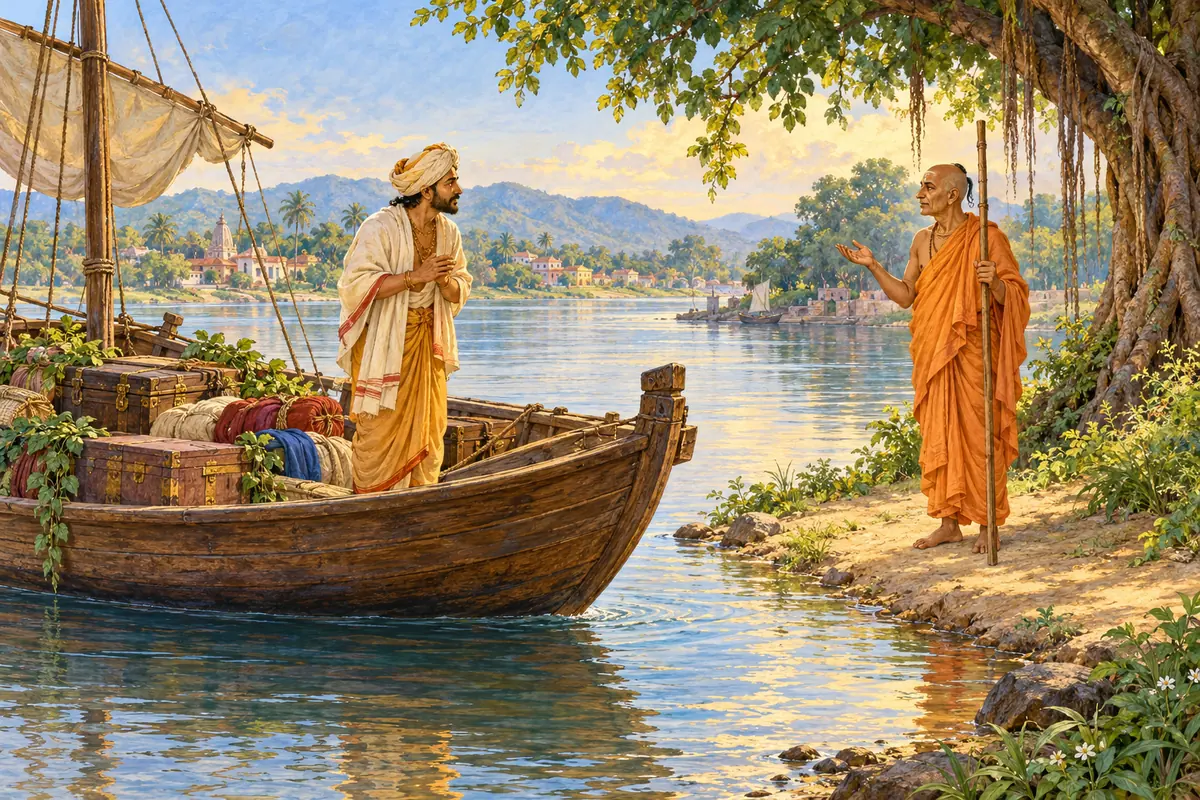
Chapter 4. On the way home, the Lord came as an ascetic with a staff and asked what the boat was carrying. “Only creepers and leaves,” the merchant lied, and at once that was all the boat held. Ashamed, Sadhu begged forgiveness, and his treasure returned. When the boat reached home, Kalavati was in the middle of the vrat. Hearing that her husband had arrived, she ran to the river without taking the prasad, and the boat with her husband sank from sight. A voice from the sky told her to go back and take the prasad. She did, and her husband rose safely from the water.
Chapter 5. King Tungadhvaja, out hunting, came upon cowherds worshipping Satyanarayan. Proud of his rank, he did not bow and refused the prasad they offered him. Soon he lost his sons and his wealth. Understanding his mistake, he returned to the cowherds, worshipped with them, took the prasad humbly, and all that he had lost was restored.
The katha ends by saying that those who keep the vrat with faith find peace in this life. It also tells that the poor Brahmin was later born as Sudama, King Ulkamukha as Dasharatha, the merchant as King Moradhvaja, King Tungadhvaja as Svayambhuva Manu, and the woodcutter as Guha, the Nishada chief who helped Rama.