Kept by families across India · Any day, especially in the evening; many families choose a Purnima (full moon) or a happy occasion
Satyanarayan katha, step by step
How to read the Roman letters
ā, ī, ū are long vowels (as in father, machine, rule). ṛ sounds like ri. ś and ṣ are both close to sh. c is ch as in church; ch is the aspirated chh. ṃ is a nasal m; ḥ is a soft echo of the vowel before it. ṭ, ḍ, ṇ are said with the tongue curled back.
Prepare the place and the prasad
Set up the chowki with the image of Satyanarayan, the kalash if you use one, and the puja plate. Make the prasad and the panchamrit, and invite family and friends.
The aarti speaks of prasad offered in a measure of one and a quarter (savaya): many families take each ingredient in sava units.
Our family’s way
Saved only on this device. Your family book →
Begin with Ganesha
Light the lamp, purify with water, and remember Ganesha before any puja.
These are the same opening texts used in the festival companions.
Purification shloka (pavitrīkaraṇa)
अपवित्रः पवित्रो वा सर्वावस्थां गतोऽपि वा।
यः स्मरेत्पुण्डरीकाक्षं स बाह्याभ्यन्तरः शुचिः॥
apavitraḥ pavitro vā sarvāvasthāṃ gato'pi vā|
yaḥ smaretpuṇḍarīkākṣaṃ sa bāhyābhyantaraḥ śuciḥ||
Whether impure or pure, in whatever state one may be, whoever remembers the lotus-eyed Lord (Vishnu) becomes pure, outside and within.
कोई अपवित्र हो या पवित्र, किसी भी अवस्था में हो — जो कमलनयन भगवान विष्णु का स्मरण करता है, वह बाहर और भीतर से शुद्ध हो जाता है।
Lamp prayer (dīpa-jyoti)
शुभं करोति कल्याणमारोग्यं धनसम्पदा।
शत्रुबुद्धिविनाशाय दीपज्योतिर्नमोऽस्तु ते॥
śubhaṃ karoti kalyāṇamārogyaṃ dhanasampadā|
śatrubuddhivināśāya dīpajyotirnamo'stu te||
O light of the lamp, you bring auspiciousness, well-being, health and wealth, and you destroy hostile thinking: salutations to you.
हे दीप की ज्योति! तुम शुभ, कल्याण, आरोग्य और धन-सम्पदा देती हो और शत्रुता की बुद्धि का नाश करती हो — तुम्हें नमस्कार।
The project manuscript reads धनसम्पदाम्, and some families say धनसम्पदः; the meaning is the same. Drik Panchang prints a related prayer to the row of lamps that begins शुभं करोतु कल्याणमारोग्यं सुख-सम्पदम्.
Remembering Ganesha (Vakratuṇḍa)
वक्रतुण्ड महाकाय सूर्यकोटिसमप्रभ।
निर्विघ्नं कुरु मे देव सर्वकार्येषु सर्वदा॥
vakratuṇḍa mahākāya sūryakoṭisamaprabha|
nirvighnaṃ kuru me deva sarvakāryeṣu sarvadā||
O Lord with the curving trunk and mighty body, radiant as ten million suns: always keep all my undertakings free of obstacles.
हे वक्र सूँड़ वाले, विशाल शरीर वाले, करोड़ों सूर्यों के समान तेजस्वी देव! मेरे सभी कार्यों को सदा विघ्नरहित करें।
ॐ श्रीगणेशाय नमः।
oṃ śrīgaṇeśāya namaḥ|
Om, salutation to Shri Ganesha.
ॐ, श्री गणेश को नमस्कार।
Our family’s way
Saved only on this device. Your family book →
Worship Satyanarayan
Remember Vishnu with the meditation verse, then offer roli, akshat, flowers, incense and lamp. Bathe the Shaligram or offer panchamrit, as your family does.
Place a tulsi leaf on the prasad you offer.
Remembering Vishnu · Śāntākāram
शान्ताकारं भुजगशयनं पद्मनाभं सुरेशं
विश्वाधारं गगनसदृशं मेघवर्णं शुभाङ्गम्।
लक्ष्मीकान्तं कमलनयनं योगिभिर्ध्यानगम्यं
वन्दे विष्णुं भवभयहरं सर्वलोकैकनाथम्॥
śāntākāraṃ bhujagaśayanaṃ padmanābhaṃ sureśaṃ
viśvādhāraṃ gaganasadṛśaṃ meghavarṇaṃ śubhāṅgam|
lakṣmīkāntaṃ kamalanayanaṃ yogibhirdhyānagamyaṃ
vande viṣṇuṃ bhavabhayaharaṃ sarvalokaikanātham||
I bow to Vishnu: serene in form, resting on the serpent, with a lotus at his navel, lord of the gods; support of the universe, vast as the sky, dark as a rain cloud, of auspicious form; beloved of Lakshmi, lotus-eyed, reached by yogis in meditation; who takes away the fear of worldly life, the one lord of all the worlds.
मैं विष्णु को प्रणाम करता/करती हूँ: जो शान्त-स्वरूप हैं, शेषनाग की शय्या पर विराजमान हैं, जिनकी नाभि में कमल है, जो देवताओं के स्वामी हैं; जो विश्व के आधार, आकाश के समान व्यापक, मेघ के समान श्याम-वर्ण और शुभ अंगों वाले हैं; जो लक्ष्मी के प्रिय, कमल-नयन और योगियों को ध्यान से प्राप्त होने वाले हैं; जो संसार के भय को हरते हैं और सब लोकों के एकमात्र स्वामी हैं।
शान्ताकारं … सर्वलोकैकनाथम् is the reading of shlokam, sanskritdocuments and Drik. In the third line, another reading (sanskritdocuments notes it in brackets; shlokam’s Vishnu Sahasranama has it) is योगिहृद्ध्यानगम्यं, “reached in meditation in the hearts of yogis”.
Our family’s way
Saved only on this device. Your family book →
Hear the katha
Read or listen to the five chapters of the katha with the whole family, holding a little akshat or a flower, and offer it at the end of each chapter.
Our retelling of the five chapters is on the story page. If a priest reads the traditional katha, follow along with it.
Our family’s way
Saved only on this device. Your family book →
Aarti
Sing the Satyanarayan aarti with camphor or the ghee lamp.
Many families also sing Om Jai Jagdish Hare.
Satyanarayan aarti · Jai Lakshmi Ramana
जय लक्ष्मी रमणा, स्वामी जय लक्ष्मी रमणा।
सत्यनारायण स्वामी, जन-पातक-हरणा॥
Jai Lakshmi ramana, swami jai Lakshmi ramana.
Satyanarayan swami, jan-patak-harana.
Victory to the beloved of Lakshmi! O Lord Satyanarayan, you take away people’s sins.
लक्ष्मीपति की जय! हे स्वामी सत्यनारायण, आप लोगों के पाप हरने वाले हैं।
Drik reads श्री जय लक्ष्मीरमणा; Bharatdiscovery reads श्री लक्ष्मी रमणा.
रत्न जड़ित सिंहासन, अद्भुत छवि राजे।
नारद करत निराजन, घंटा ध्वनि बाजे॥
Ratn jadit sinhasan, adbhut chhavi raje.
Narad karat nirajan, ghanta dhvani baje.
On a jewel-studded throne your wondrous form shines; Narada waves the lamp in worship and the bell rings out.
रत्नों से जड़े सिंहासन पर आपकी अद्भुत छवि शोभित है; नारद आरती उतारते हैं और घण्टे की ध्वनि गूँजती है।
प्रकट भये कलि कारण, द्विज को दरस दियो।
बूढ़ो ब्राह्मण बनकर, कंचन महल कियो॥
Prakat bhaye kali karan, dvij ko daras diyo.
Budho brahman bankar, kanchan mahal kiyo.
For the sake of the Kali age you appeared and showed yourself to a Brahmin; taking the form of an old Brahmin, you turned his home into a golden palace.
कलियुग के कारण आप प्रकट हुए और एक ब्राह्मण को दर्शन दिए; बूढ़े ब्राह्मण का रूप लेकर उसका घर सोने का महल बना दिया।
This and the next stanzas recall the katha: the poor Brahmin and the woodcutter (chapter 2), the merchant (chapters 3–4) and the king with the cowherds (chapter 5). Drik and BhaktiBharat spell दर्श.
दुर्बल भील कठारो, जिन पर कृपा करी।
चन्द्रचूड़ एक राजा, तिनकी बिपति हरी॥
Durbal bhil katharo, jin par kripa kari.
Chandrachud ek raja, tinki bipati hari.
You showed grace to the poor tribal woodcutter, and you took away the troubles of a king named Chandrachud.
आपने निर्धन भील लकड़हारे पर कृपा की, और चन्द्रचूड़ नाम के एक राजा की विपत्ति हरी।
Drik reads इन पर … जिनकी विपति; Bharatdiscovery reads जिनकी बिपति.
वैश्य मनोरथ पायो, श्रद्धा तज दीन्ही।
सो फल भोग्यो प्रभुजी, फिर स्तुति कीन्ही॥
Vaishya manorath payo, shraddha taj dinhi.
So phal bhogyo prabhuji, phir stuti kinhi.
The merchant gained his wish but abandoned his faith; he suffered the consequence, Lord, and then praised you once more.
व्यापारी ने मनोकामना पाई पर श्रद्धा छोड़ दी; हे प्रभु, उसने उसका फल भोगा और फिर आपकी स्तुति की।
भाव भक्ति के कारण, छिन-छिन रूप धर्यो।
श्रद्धा धारण कीन्ही, तिनको काज सर्यो॥
Bhav bhakti ke karan, chhin-chhin rup dharyo.
Shraddha dharan kinhi, tinko kaj saryo.
For the sake of loving devotion you took form again and again; those who held on to faith had their tasks fulfilled.
प्रेम और भक्ति के कारण आपने क्षण-क्षण रूप धारण किए; जिन्होंने श्रद्धा रखी, उनके काम सिद्ध हुए।
ग्वाल-बाल संग राजा, वन में भक्ति करी।
मनवांछित फल दीन्हों, दीनदयाल हरी॥
Gval-bal sang raja, van mein bhakti kari.
Manvanchhit phal dinhon, dindayal Hari.
With the cowherd boys a king worshipped you in the forest; Hari, kind to the humble, gave him what he longed for.
ग्वाल-बालों के साथ राजा ने वन में भक्ति की; दीनों पर दया करने वाले हरि ने उसे मनचाहा फल दिया।
Bharatdiscovery and Aaj Tak read दीनदयालु.
चढ़त प्रसाद सवायो, कदली फल मेवा।
धूप दीप तुलसी से, राजी सत्यदेवा॥
Chadhat prasad savayo, kadli phal meva.
Dhup dip tulsi se, raji Satyadeva.
Prasad is offered in a measure of one and a quarter, with bananas and dry fruit; the Lord of Truth is pleased with incense, lamp and tulsi.
सवाये (सवा गुने) माप में प्रसाद, केले और मेवे चढ़ते हैं; धूप, दीप और तुलसी से सत्यदेव प्रसन्न होते हैं।
सवायो means one and a quarter: many families measure each ingredient of the prasad in sava units. Drik reads सवाया.
श्री सत्यनारायण जी की आरती, जो कोई नर गावे।
तन-मन-सुख-सम्पत्ति, मनवांछित फल पावे॥
Shri Satyanarayan ji ki aarti, jo koi nar gave.
Tan-man-sukh-sampatti, manvanchhit phal pave.
Whoever sings this aarti of Shri Satyanarayan gains well-being of body and mind, prosperity and the fruit of their wishes.
जो कोई श्री सत्यनारायण जी की यह आरती गाता है, वह तन-मन का सुख, सम्पत्ति और मनचाहा फल पाता है।
This closing is the one found in two copies (Bharatdiscovery, Aaj Tak). Drik closes with the poet’s signature कहत शिवानन्द स्वामी मनवांछित फल पावे; BhaktiBharat closes with ऋद्धि-सिद्ध सुख-संपत्ति सहज रूप पावे.
Our family’s way
Saved only on this device. Your family book →
Share the prasad with everyone
Give panchamrit and prasad to everyone present, and take it yourself. The katha’s lesson is never to refuse or forget the prasad.
Send prasad to neighbours and those who could not come.
Our family’s way
Saved only on this device. Your family book →
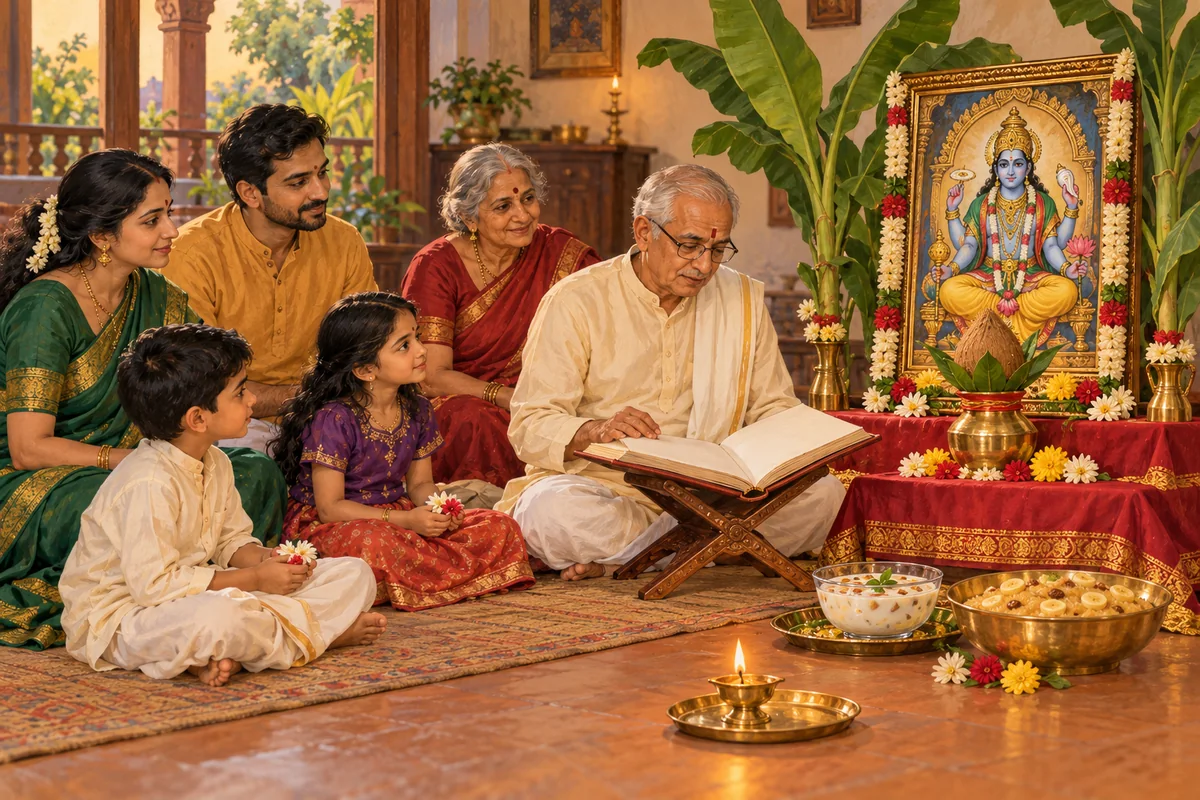
May truth and faith keep your family together.
If something here differs from your family's practice, follow your family.