Common North Indian household practice · Thursday, 29 October 2026
Karva Chauth Puja
How to read the Roman letters
ā, ī, ū are long vowels (as in father, machine, rule). ṛ sounds like ri. ś and ṣ are both close to sh. c is ch as in church; ch is the aspirated chh. ṃ is a nasal m; ḥ is a soft echo of the vowel before it. ṭ, ḍ, ṇ are said with the tongue curled back.
Before sunrise: sargi and sankalpa
If sargi is part of your family's custom, eat it before dawn and drink water. After bathing, take the sankalpa: state in your own words that you will keep the fast until moonrise.
Sargi is usually eaten before sunrise; after that the fast begins. The sankalpa can be said in your own language; the Sanskrit formula is given for families who use it.
Sankalpa template · adapt it“Today, on Karva Chauth, I, [your name], keep this fast with devotion for the long life, health and happiness of my husband and our family, until I see the moon.”
Karva Chauth sankalpa
मम सुखसौभाग्य पुत्रपौत्रादि सुस्थिर श्री प्राप्तये करक चतुर्थी व्रतमहं करिष्ये।
mama sukhasaubhāgya putrapautrādi susthira śrī prāptaye karaka caturthī vratamahaṃ kariṣye|
For my happiness and good fortune, for the well-being of my children and grandchildren, and for lasting prosperity, I shall keep the Karaka Chaturthi fast.
अपने सुख-सौभाग्य, पुत्र-पौत्र आदि के कल्याण और स्थिर समृद्धि की प्राप्ति के लिए मैं करक चतुर्थी का व्रत करूँगी/करूँगा।
Karaka Chaturthi is the scriptural name of Karva Chauth; karaka and karva both mean the small spouted pot used in the puja.
Our family’s way
Saved only on this device. Your family book →
Through the day
Keep the fast as your family does. Rest when you can. Many women apply mehndi and dress in festive clothes for the evening.
If you feel faint, dizzy or unwell, drink water and eat something; the health of the person fasting comes first. Many families keep a lighter fast for those who need it.
Our family’s way
Saved only on this device. Your family book →
Prepare for the evening puja
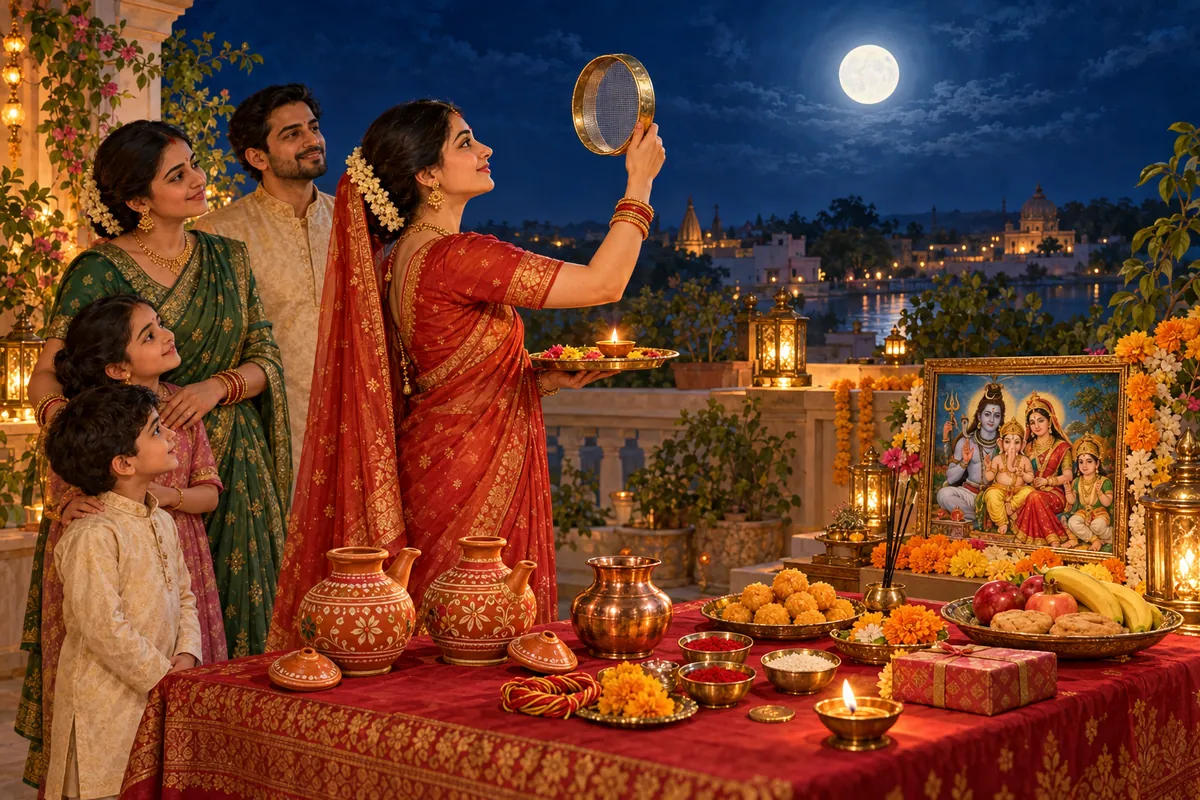
Set up the image or calendar of Gauri (Chauth Mata). Fill the karva with water, place the lamp, the plate and the sweets, and keep the sieve and the lota ready for moonrise.
Some families draw Gauri and Chauth Mata on the wall; others use a printed Karva Chauth calendar. Women of the family or neighbourhood often gather to do the puja together.
Our family’s way
Saved only on this device. Your family book →
Worship Gauri and Shiva's family
Light the lamp. Offer roli, rice, flowers and sweets to Gauri (Parvati), then to Shiva, Kartikeya and Ganesha, saying each one's name-mantra.
Gauri, worshipped as Chauth Mata, is the centre of this puja; the prayer to her asks for good fortune for the women who keep the vrat. Many families remember Ganesha first, as in every puja.
Name-mantras for Gauri and Shiva's family
Offer Gauri / Parvati (Chauth Mata)
ॐ शिवायै नमः।
oṃ śivāyai namaḥ|
Om, salutation to Shivā (Parvati).
ॐ, शिवा (पार्वती) को नमस्कार।
Offer Shiva
ॐ नमः शिवाय।
oṃ namaḥ śivāya|
Om, salutation to Shiva.
ॐ, शिव को नमस्कार।
Offer Kartikeya, the six-faced
ॐ षण्मुखाय नमः।
oṃ ṣaṇmukhāya namaḥ|
Om, salutation to the six-faced one (Kartikeya).
ॐ, छह मुख वाले (कार्तिकेय) को नमस्कार।
Offer Ganesha
ॐ गणेशाय नमः।
oṃ gaṇeśāya namaḥ|
Om, salutation to Ganesha.
ॐ, गणेश को नमस्कार।
Prayer to Gauri
नमः शिवायै शर्वाण्यै सौभाग्यं संतति शुभाम्।
प्रयच्छ भक्तियुक्तानां नारीणां हरवल्लभे॥
namaḥ śivāyai śarvāṇyai saubhāgyaṃ saṃtati śubhām|
prayaccha bhaktiyuktānāṃ nārīṇāṃ haravallabhe||
Salutations to Shivā, to Śarvāṇī. O beloved of Hara (Shiva), grant good fortune and blessed children to the women who worship you with devotion.
शिवा और शर्वाणी को नमस्कार। हे हर (शिव) की प्रिया, भक्ति से युक्त स्त्रियों को सौभाग्य और शुभ सन्तान प्रदान कीजिए।
Amar Ujala reads नमस्त्यै शिवायै … शुभा. With शुभाम्, one would grammatically expect संततिं (accusative); both copies print संतति. Left as printed for a reviewer to decide.
Our family’s way
Saved only on this device. Your family book →
Hear the Karva Chauth katha
Sit together and read or listen to the katha. In many families the women then pass their thalis around the circle, often seven times, singing the family's Karva Chauth song.
The katha is told in many versions. The one below follows the widely told story of Veeravati. The songs sung while passing the thalis differ by region and are not printed here.
Veeravati and the false moon
Veeravati was the only sister of seven brothers, and they loved her dearly. In her first year of marriage she kept the Karva Chauth fast at her parents' home, together with her sisters-in-law.
By evening she was faint with hunger and thirst, and the moon had still not risen. Her brothers could not bear to see her suffer. One of them climbed a tree some distance away, lit a lamp and held a sieve in front of it, so that its glow looked like the rising moon.
“The moon is up,” they told her. Veeravati offered arghya to the light, broke her fast and began to eat. At once bad news came: her husband had died.
In her grief Veeravati blamed herself. Indrani, queen of the gods, came to comfort her and told her the truth: she had broken her fast before the real moon rose.
Indrani advised her to keep every Chauth fast through the year with faith and patience. Veeravati did so, and by the merit of her devotion her husband was restored to her.
Families tell this story to honour patience and faithfulness. The details differ from home to home; tell it the way your family does.
An original retelling of a popular tradition; no scriptural verse is claimed. Drik Panchang’s version names Veeravati as the daughter of Vedasharma of Indraprastha; BhaktiBharat tells a similar story as Krishna’s account to Draupadi.
Our family’s way
Saved only on this device. Your family book →
Give the karva
Fill a karva with water or milk and place a coin in it. Give it, with the baya (gifts), to your mother-in-law or an elder married woman, and take her blessing.
Many families exchange karvas among the women at this point. A Sanskrit verse for giving the karva appears in Drik Panchang, but we found it in only one source, so it is not printed here.
Our family’s way
Saved only on this device. Your family book →
At moonrise: arghya to the moon
When the moon rises, look at it (many families look through the sieve), offer water from the lota towards it saying the name-mantra, and show the lamp. Then, as many families do, look at your husband through the sieve.
If clouds hide the moon, families follow their own custom: some wait, some go by the published moonrise time. Offer the arghya slowly, with a prayer for the family's well-being.
Name-mantra for the Moon
Offer Water (arghya) offered towards the moon
ॐ सोमाय नमः।
oṃ somāya namaḥ|
Om, salutation to Soma, the Moon.
ॐ, सोम (चन्द्रमा) को नमस्कार।
Our family’s way
Saved only on this device. Your family book →
Break the fast
Receive water and the first bite of food, often from your husband. Touch the feet of the elders, share the prasad and enjoy the meal together.
After a long fast, begin with water and something light before a full meal.
Our family’s way
Saved only on this device. Your family book →
May the year ahead be kind to your family.
If something here differs from your family's practice, follow your family.