Common North Indian household practice · Friday, 20 November 2026
Dev Uthani Ekadashi, step by step
How to read the Roman letters
ā, ī, ū are long vowels (as in father, machine, rule). ṛ sounds like ri. ś and ṣ are both close to sh. c is ch as in church; ch is the aspirated chh. ṃ is a nasal m; ḥ is a soft echo of the vowel before it. ṭ, ḍ, ṇ are said with the tongue curled back.
Keep the Ekadashi fast
Those who are fasting begin at sunrise and avoid grains; many keep a fruit-and-milk fast. Grains are commonly avoided from the evening before.
The fast runs until the parana the next day. Read the health note above; the fast is a choice, not a duty for those who are unwell.
Our family’s way
Saved only on this device. Your family book →
Clean the home and draw the Lord’s feet
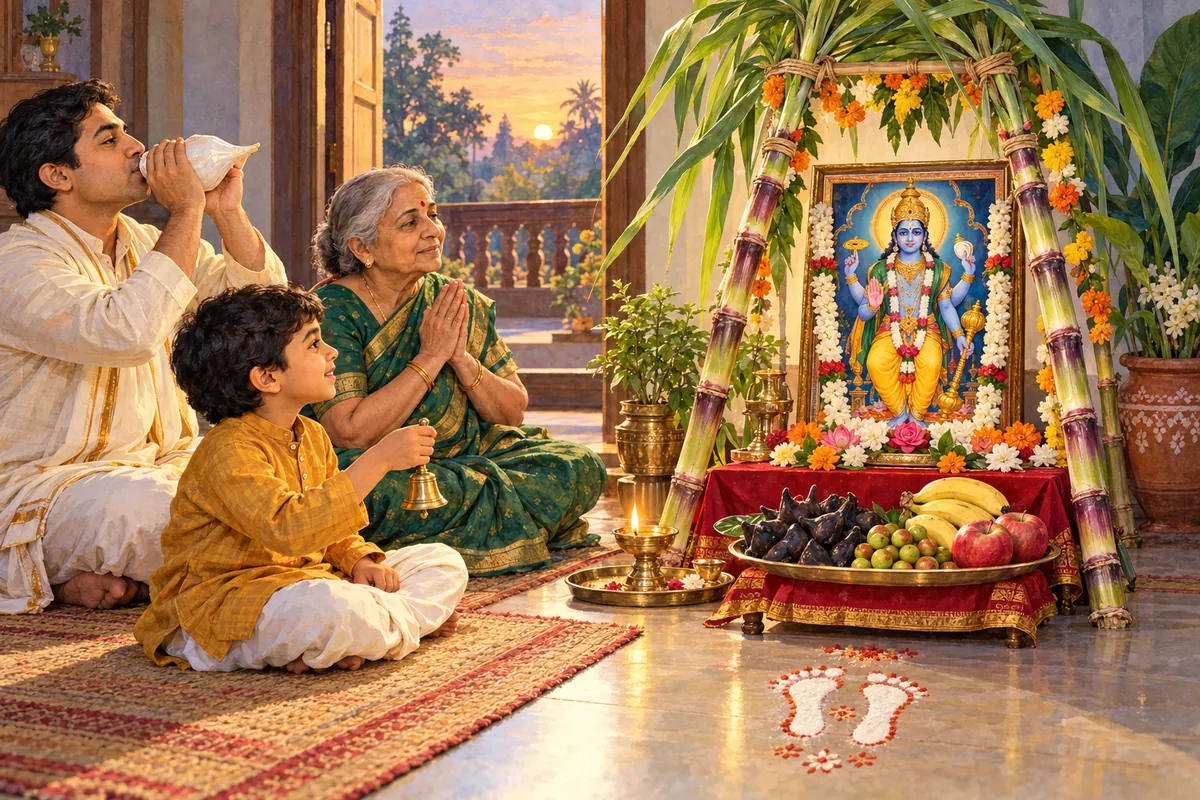
Clean the house and the courtyard or puja place. In many homes a small square (chowk) is made and the Lord’s footprints are drawn in rice paste or geru, then kept covered until the waking.
Draw the feet walking into the house, as your family does.
Our family’s way
Saved only on this device. Your family book →
Set up the sugarcane and the offerings
Tie a few sugarcane stalks into a small canopy over the puja place. Place the image of Vishnu beneath it with water chestnuts, ber, seasonal fruit and sweets, and cover the offerings with a parat or basket.
Wikipedia notes that this day also marks the start of the sugarcane harvest.
Our family’s way
Saved only on this device. Your family book →
Evening puja to Vishnu
In the evening, light the ghee lamp, offer roli, akshat and flowers, and remember Vishnu with the meditation verse and his mantra.
Many families keep a ghee lamp burning through the night.
Remembering Vishnu · Śāntākāram
शान्ताकारं भुजगशयनं पद्मनाभं सुरेशं
विश्वाधारं गगनसदृशं मेघवर्णं शुभाङ्गम्।
लक्ष्मीकान्तं कमलनयनं योगिभिर्ध्यानगम्यं
वन्दे विष्णुं भवभयहरं सर्वलोकैकनाथम्॥
śāntākāraṃ bhujagaśayanaṃ padmanābhaṃ sureśaṃ
viśvādhāraṃ gaganasadṛśaṃ meghavarṇaṃ śubhāṅgam|
lakṣmīkāntaṃ kamalanayanaṃ yogibhirdhyānagamyaṃ
vande viṣṇuṃ bhavabhayaharaṃ sarvalokaikanātham||
I bow to Vishnu: serene in form, resting on the serpent, with a lotus at his navel, lord of the gods; support of the universe, vast as the sky, dark as a rain cloud, of auspicious form; beloved of Lakshmi, lotus-eyed, reached by yogis in meditation; who takes away the fear of worldly life, the one lord of all the worlds.
मैं विष्णु को प्रणाम करता/करती हूँ: जो शान्त-स्वरूप हैं, शेषनाग की शय्या पर विराजमान हैं, जिनकी नाभि में कमल है, जो देवताओं के स्वामी हैं; जो विश्व के आधार, आकाश के समान व्यापक, मेघ के समान श्याम-वर्ण और शुभ अंगों वाले हैं; जो लक्ष्मी के प्रिय, कमल-नयन और योगियों को ध्यान से प्राप्त होने वाले हैं; जो संसार के भय को हरते हैं और सब लोकों के एकमात्र स्वामी हैं।
शान्ताकारं … सर्वलोकैकनाथम् is the reading of shlokam, sanskritdocuments and Drik. In the third line, another reading (sanskritdocuments notes it in brackets; shlokam’s Vishnu Sahasranama has it) is योगिहृद्ध्यानगम्यं, “reached in meditation in the hearts of yogis”.
Om namo bhagavate Vāsudevāya
ॐ नमो भगवते वासुदेवाय॥
oṃ namo bhagavate vāsudevāya||
Om, salutations to the Lord Vasudeva.
ॐ, भगवान वासुदेव को नमस्कार।
Many families repeat it 108 times on a mala.
Our family’s way
Saved only on this device. Your family book →
Wake the Lord
Uncover the offerings and wake the Lord with conch, bells and the waking verses, at the time your family keeps: many at dawn, others in the evening puja.
In some homes a plate or winnowing basket is beaten at this moment, and families sing their own waking songs.
Waking the Lord · Uttiṣṭhottiṣṭha Govinda
उत्तिष्ठोत्तिष्ठ गोविन्द उत्तिष्ठ गरुडध्वज।
उत्तिष्ठ कमलाकान्त त्रैलोक्यं मङ्गलं कुरु॥
uttiṣṭhottiṣṭha govinda uttiṣṭha garuḍadhvaja|
uttiṣṭha kamalākānta trailokyaṃ maṅgalaṃ kuru||
Rise, rise, O Govinda! Rise, O you whose banner bears Garuda! Rise, O beloved of Kamala, and make the three worlds auspicious.
उठिए, उठिए, हे गोविन्द! उठिए, हे गरुडध्वज! उठिए, हे कमलाकान्त (लक्ष्मीपति), और तीनों लोकों का मंगल कीजिए।
Waking the Lord · Tyaja nidrāṃ jagatpate
उत्तिष्ठोत्तिष्ठ गोविन्द त्यज निद्रां जगत्पते।
त्वयि सुप्ते जगन्नाथ जगत् सुप्तमिदं भवेत्॥
uttiṣṭhottiṣṭha govinda tyaja nidrāṃ jagatpate|
tvayi supte jagannātha jagat suptamidaṃ bhavet||
Rise, rise, O Govinda; give up your sleep, O Lord of the world. While you sleep, O Lord of the universe, this whole world sleeps.
उठिए, उठिए, हे गोविन्द; हे जगत्पति, निद्रा त्यागिए। हे जगन्नाथ, आपके सोने से यह सारा जगत सोया रहता है।
Aaj Tak and Panchjanya (counted as one copy) read उत्तिष्ठ गोविन्द … जगत्पतये … जगत् सुप्तं भवेदिदम्.
Our family’s way
Saved only on this device. Your family book →
Aarti
Sing Om Jai Jagdish Hare and offer the fruit and sweets as prasad.
Some families keep a night of kirtan and stories after the aarti.
Aarti · Om Jai Jagdish Hare
ॐ जय जगदीश हरे, स्वामी जय जगदीश हरे।
भक्त जनों के संकट, क्षण में दूर करे॥
Om jai Jagdish Hare, swami jai Jagdish Hare.
Bhakt janon ke sankat, kshan mein door kare.
Om, victory to Hari, Lord of the universe! You remove your devotees' troubles in an instant.
ॐ, जगत के स्वामी हरि की जय हो! आप भक्तों के संकट क्षण भर में दूर कर देते हैं।
जो ध्यावे फल पावे, दुख बिनसे मन का।
सुख सम्पत्ति घर आवे, कष्ट मिटे तन का॥
Jo dhyave phal pave, dukh binse man ka.
Sukh sampatti ghar aave, kasht mite tan ka.
Whoever meditates on you receives the reward: sorrow leaves the mind, happiness and prosperity come home, and the body's pain ends.
जो आपका ध्यान करता है, वह फल पाता है: मन का दुःख नष्ट होता है, घर में सुख-सम्पत्ति आती है और शरीर का कष्ट मिटता है।
मात पिता तुम मेरे, शरण गहूँ मैं किसकी।
तुम बिन और न दूजा, आस करूँ मैं जिसकी॥
Mat pita tum mere, sharan gahoon main kiski.
Tum bin aur na dooja, aas karoon main jiski.
You are my mother and father; in whom else would I take refuge? Without you there is no other in whom I could place my hope.
आप ही मेरे माता-पिता हैं; मैं और किसकी शरण लूँ? आपके बिना कोई दूसरा नहीं, जिससे मैं आशा रखूँ।
Drik Panchang reads आस करूँ जिसकी (without मैं).
तुम पूरण परमात्मा, तुम अन्तर्यामी।
पारब्रह्म परमेश्वर, तुम सबके स्वामी॥
Tum pooran Paramatma, tum antaryami.
Parabrahma Parameshvar, tum sabke swami.
You are the complete Supreme Self, the one who dwells within all; the transcendent Brahman, the Supreme Lord, master of all.
आप पूर्ण परमात्मा और सबके भीतर की जानने वाले अन्तर्यामी हैं। आप परब्रह्म परमेश्वर और सबके स्वामी हैं।
तुम करुणा के सागर, तुम पालनकर्ता।
मैं सेवक तुम स्वामी, कृपा करो भर्ता॥
Tum karuna ke sagar, tum palankarta.
Main sevak tum swami, kripa karo bharta.
You are an ocean of compassion, the one who sustains all. I am your servant and you are my master: be gracious, O provider.
आप करुणा के सागर और सबका पालन करने वाले हैं। मैं सेवक हूँ, आप स्वामी हैं — हे भरण-पोषण करने वाले, कृपा कीजिए।
Drik Panchang reads मैं मूरख खल कामी (“I am foolish, wicked and full of desire”); some families sing मैं मूरख फलकामी.
तुम हो एक अगोचर, सबके प्राणपति।
किस विधि मिलूँ दयामय, तुमको मैं कुमति॥
Tum ho ek agochar, sabke pranpati.
Kis vidhi miloon dayamay, tumko main kumati.
You are the One beyond the senses, the lord of every life. How can I, of poor understanding, reach you, O merciful one?
आप एक हैं, इन्द्रियों से परे हैं और सबके प्राणों के स्वामी हैं। हे दयामय, मैं अल्पबुद्धि आपसे किस विधि मिलूँ?
दीनबन्धु दुखहर्ता, तुम रक्षक मेरे।
करुणा हस्त बढ़ाओ, द्वार पड़ा तेरे॥
Deenbandhu dukhharta, tum rakshak mere.
Karuna hast badhao, dvar pada tere.
Friend of the helpless, remover of sorrow, you are my protector. Reach out your hand in compassion; I lie at your door.
हे दीनबन्धु, दुःख हरने वाले, आप मेरे रक्षक हैं। करुणा का हाथ बढ़ाइए; मैं आपके द्वार पर पड़ा हूँ।
Drik Panchang reads तुम ठाकुर मेरे (“you are my lord”) and अपने हाथ उठाओ (“raise your hand”).
विषय विकार मिटाओ, पाप हरो देवा।
श्रद्धा भक्ति बढ़ाओ, सन्तन की सेवा॥
Vishay vikar mitao, paap haro deva.
Shraddha bhakti badhao, santan ki seva.
Remove my cravings and faults; take away my wrongdoing, O Lord. Increase my faith, my devotion and my service to the saintly.
विषयों की वासना और विकार मिटाइए; हे देव, पाप हरिए। श्रद्धा, भक्ति और सन्तों की सेवा बढ़ाइए।
Our family’s way
Saved only on this device. Your family book →
Break the fast the next day (parana)
Break the fast on Dwadashi, after sunrise and after Hari Vasara, the first quarter of Dwadashi, has ended. For Gurugram in 2026, Drik Panchang gives 01:11 PM to 03:19 PM on 21 November.
Drik Panchang advises breaking the fast early in the morning when possible and avoiding midday, which is why its window this year starts after 1 PM. ISKCON’s guidance prefers the first third of the daylight. Follow your family’s calendar. Tulsi Vivah is often celebrated the same evening.
Our family’s way
Saved only on this device. Your family book →
May the Lord’s waking bring blessings to your home.
If something here differs from your family's practice, follow your family.