Common North Indian household method · Sunday, 8 November 2026
Lakshmi–Ganesha Puja
How to read the Roman letters
ā, ī, ū are long vowels (as in father, machine, rule). ṛ sounds like ri. ś and ṣ are both close to sh. c is ch as in church; ch is the aspirated chh. ṃ is a nasal m; ḥ is a soft echo of the vowel before it. ṭ, ḍ, ṇ are said with the tongue curled back.
Prepare the home and the puja place
Clean the home, draw rangoli at the entrance, bathe and wear clean clothes. Set up the chowki and keep every item within reach.
For many families, cleaning and decorating the home is part of Diwali itself. Set the chowki where the whole family can sit together; many families sit facing east or north. Place the Ganesha–Lakshmi image or idols, the kalash if you use one, the main lamp and the puja plate. Leave clear space around the lamp. Have everything ready before the muhurat so that the puja itself is unhurried.
HOW IT IS ARRANGED
The puja place, labelled
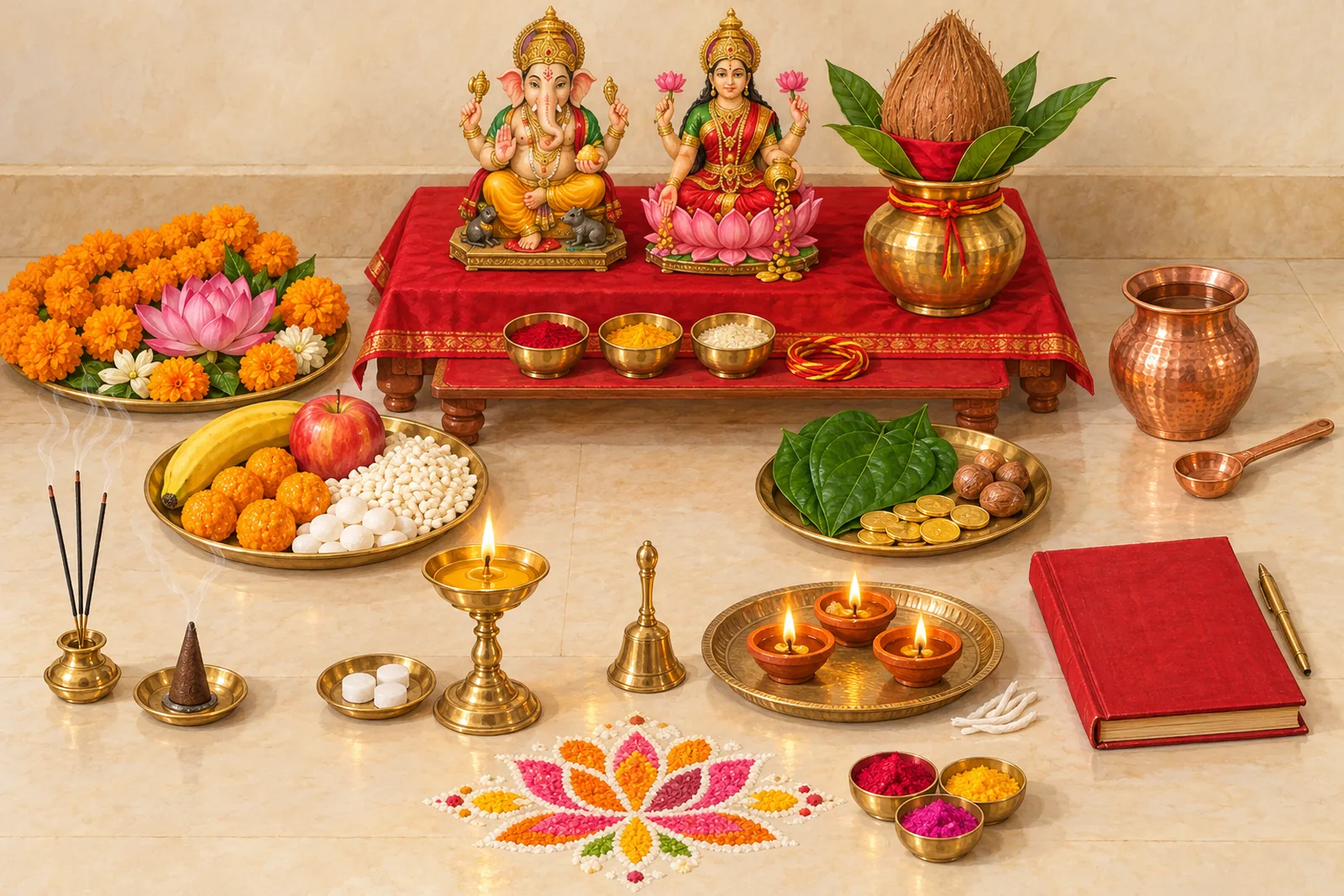 12345678910111213
- Ganesha and Lakshmi गणेश और लक्ष्मी
- Kalash कलश
- Flowers and garland फूल और माला
- Roli, haldi, akshat, mauli रोली, हल्दी, अक्षत, मौली
- Lota and spoon लोटा और आचमनी
- Chowki with red cloth लाल कपड़े से ढकी चौकी
- Sweets and fruit मिठाई और फल
- Paan, supari, coins पान, सुपारी, सिक्के
- Incense धूप-अगरबत्ती
- Ghee lamp, camphor, bell घी का दीपक, कपूर, घंटी
- Clay diyas and wicks मिट्टी के दीये और बाती
- Account book बही-खाता
- Rangoli colours रंगोली के रंग
One common arrangement; families differ. Follow your family’s practice.
Our family’s way
Saved only on this device. Your family book →
Purify yourself and the place
Sit down, take a little water in your right palm, recite the shloka, and sprinkle the water on yourself, the family and the puja items.
This is pavitrīkaraṇa, a remembrance that prepares body and mind. Those who know āchamana sip a little water three times, saying one name of Vishnu with each sip, and then wash the right hand. If you are unsure, simply sprinkle the water.
Purification shloka (pavitrīkaraṇa)
अपवित्रः पवित्रो वा सर्वावस्थां गतोऽपि वा।
यः स्मरेत्पुण्डरीकाक्षं स बाह्याभ्यन्तरः शुचिः॥
apavitraḥ pavitro vā sarvāvasthāṃ gato'pi vā|
yaḥ smaretpuṇḍarīkākṣaṃ sa bāhyābhyantaraḥ śuciḥ||
Whether impure or pure, in whatever state one may be, whoever remembers the lotus-eyed Lord (Vishnu) becomes pure, outside and within.
कोई अपवित्र हो या पवित्र, किसी भी अवस्था में हो — जो कमलनयन भगवान विष्णु का स्मरण करता है, वह बाहर और भीतर से शुद्ध हो जाता है।
Āchamana (three sips of water)
ॐ केशवाय स्वाहा। ॐ नारायणाय स्वाहा। ॐ माधवाय स्वाहा।
oṃ keśavāya svāhā| oṃ nārāyaṇāya svāhā| oṃ mādhavāya svāhā|
Om, to Keshava, svāhā. Om, to Narayana, svāhā. Om, to Madhava, svāhā. (Three names of Vishnu, one with each sip; svāhā marks an offering.)
ॐ केशव को स्वाहा। ॐ नारायण को स्वाहा। ॐ माधव को स्वाहा। (भगवान विष्णु के तीन नाम, हर घूँट के साथ एक; “स्वाहा” अर्पण का सूचक है।)
Corrected on 14 October 2026: both independent copies read स्वाहा, the classical āchamana form. An earlier version followed the project manuscript and printed नमः; no written copy of that form was found.
Our family’s way
Saved only on this device. Your family book →
Light the main lamp
Light the main ghee lamp, set it on a steady base, and recite the lamp prayer.
The main lamp stays lit through the puja. Some families keep it burning all night. If you do, use a deep holder with plenty of ghee, keep it well away from anything that can catch fire, and make sure an adult stays awake to watch it.
Lamp prayer (dīpa-jyoti)
शुभं करोति कल्याणमारोग्यं धनसम्पदा।
शत्रुबुद्धिविनाशाय दीपज्योतिर्नमोऽस्तु ते॥
śubhaṃ karoti kalyāṇamārogyaṃ dhanasampadā|
śatrubuddhivināśāya dīpajyotirnamo'stu te||
O light of the lamp, you bring auspiciousness, well-being, health and wealth, and you destroy hostile thinking: salutations to you.
हे दीप की ज्योति! तुम शुभ, कल्याण, आरोग्य और धन-सम्पदा देती हो और शत्रुता की बुद्धि का नाश करती हो — तुम्हें नमस्कार।
The project manuscript reads धनसम्पदाम्, and some families say धनसम्पदः; the meaning is the same. Drik Panchang prints a related prayer to the row of lamps that begins शुभं करोतु कल्याणमारोग्यं सुख-सम्पदम्.
Our family’s way
Saved only on this device. Your family book →
State your intention (sankalpa)
Hold a little water, rice and a flower in your right hand. Say who is worshipping, where and why, in your own language, then place them before the deities.
A priest recites a full Sanskrit sankalpa naming the year, month, place and family lineage. At home, a sincere sankalpa in your own words is a common and accepted practice. Adapt the template below.
Sankalpa template · adapt it“Today, on the new-moon night of Diwali, I, [your name], with my family, in [your city], worship Shri Ganesha and Shri Mahalakshmi with devotion, for the well-being, harmony and prosperity of our family. May this worship be accepted.”
Our family’s way
Saved only on this device. Your family book →
Worship Ganesha first
Remember Ganesha with the Vakratuṇḍa shloka. Then offer a little of each item, saying its line each time.
Ganesha is worshipped first so that the puja proceeds without obstacles. What matters is attention and care, not the quantity offered. If you are using a paper picture, sprinkle water with a flower rather than pouring it.
Remembering Ganesha (Vakratuṇḍa)
वक्रतुण्ड महाकाय सूर्यकोटिसमप्रभ।
निर्विघ्नं कुरु मे देव सर्वकार्येषु सर्वदा॥
vakratuṇḍa mahākāya sūryakoṭisamaprabha|
nirvighnaṃ kuru me deva sarvakāryeṣu sarvadā||
O Lord with the curving trunk and mighty body, radiant as ten million suns: always keep all my undertakings free of obstacles.
हे वक्र सूँड़ वाले, विशाल शरीर वाले, करोड़ों सूर्यों के समान तेजस्वी देव! मेरे सभी कार्यों को सदा विघ्नरहित करें।
ॐ श्रीगणेशाय नमः।
oṃ śrīgaṇeśāya namaḥ|
Om, salutation to Shri Ganesha.
ॐ, श्री गणेश को नमस्कार।
Offerings to Ganesha
Offer Roli, kumkum or sandal paste
ॐ श्रीगणेशाय नमः। गन्धं समर्पयामि।
oṃ śrīgaṇeśāya namaḥ| gandhaṃ samarpayāmi|
Salutation to Shri Ganesha. I offer fragrant paste.
श्री गणेश को नमस्कार। सुगन्धित चन्दन/रोली अर्पित करता/करती हूँ।
Offer Unbroken rice (akshat)
ॐ श्रीगणेशाय नमः। अक्षतान् समर्पयामि।
oṃ śrīgaṇeśāya namaḥ| akṣatān samarpayāmi|
I offer unbroken rice.
अक्षत अर्पित करता/करती हूँ।
Offer Flowers
ॐ श्रीगणेशाय नमः। पुष्पाणि समर्पयामि।
oṃ śrīgaṇeśāya namaḥ| puṣpāṇi samarpayāmi|
I offer flowers.
फूल अर्पित करता/करती हूँ।
Offer Incense
ॐ श्रीगणेशाय नमः। धूपम् आघ्रापयामि।
oṃ śrīgaṇeśāya namaḥ| dhūpam āghrāpayāmi|
I offer the fragrance of incense.
धूप की सुगन्ध अर्पित करता/करती हूँ।
Offer Lamp
ॐ श्रीगणेशाय नमः। दीपं दर्शयामि।
oṃ śrīgaṇeśāya namaḥ| dīpaṃ darśayāmi|
I show the lamp.
दीप दिखाता/दिखाती हूँ।
Offer Sweets, such as laddoo
ॐ श्रीगणेशाय नमः। नैवेद्यं निवेदयामि।
oṃ śrīgaṇeśāya namaḥ| naivedyaṃ nivedayāmi|
I offer food.
नैवेद्य (भोग) निवेदित करता/करती हूँ।
Our family’s way
Saved only on this device. Your family book →
Honour the kalash (if installed)
Touch the kalash, offer roli, rice and a flower, and recite the kalash shloka. Skip this step if your family does not install a kalash.
Many households install a kalash as a seat of auspiciousness for the puja. The shloka remembers the deities said to dwell in the vessel.
Kalash shloka
कलशस्य मुखे विष्णुः कण्ठे रुद्रः समाश्रितः।
मूले तस्य स्थितो ब्रह्मा मध्ये मातृगणाः स्मृताः॥
kalaśasya mukhe viṣṇuḥ kaṇṭhe rudraḥ samāśritaḥ|
mūle tasya sthito brahmā madhye mātṛgaṇāḥ smṛtāḥ||
Vishnu dwells at the mouth of the kalash and Rudra at its neck. Brahma is at its base, and the Mothers (Mātṛkās) are remembered as dwelling in its middle.
कलश के मुख में विष्णु, कण्ठ में रुद्र, मूल (तल) में ब्रह्मा और मध्य भाग में मातृगण स्थित माने गए हैं।
sanskritdocuments reads मूले तत्र स्थितो ब्रह्म; Drik Panchang prints कण्ठं for कण्ठे.
Our family’s way
Saved only on this device. Your family book →
Invite and worship Mahalakshmi
With folded hands and flowers, invite Mahalakshmi. Then offer each item in turn, saying its line.
These are the familiar upachāras, the offerings made to an honoured guest: a seat, water, a bath, cloth, fragrance, rice, flowers, incense, a lamp, food, betel and a gift. For a metal idol, families who know the method bathe it with panchamrit and then clean water. For a picture, sprinkle water with a flower. Place the coins, and any account books or new items your family blesses, before Lakshmi at the dakshina offering.
Invitation and offerings to Mahalakshmi
Offer Flowers held with folded hands
ॐ श्रीमहालक्ष्म्यै नमः। श्रीमहालक्ष्मीम् आवाहयामि।
oṃ śrīmahālakṣmyai namaḥ| śrīmahālakṣmīm āvāhayāmi|
Salutation to Shri Mahalakshmi. I invite Shri Mahalakshmi.
श्री महालक्ष्मी को नमस्कार। श्री महालक्ष्मी का आवाहन करता/करती हूँ।
Offer A flower placed as her seat
ॐ श्रीमहालक्ष्म्यै नमः। आसनं समर्पयामि।
oṃ śrīmahālakṣmyai namaḥ| āsanaṃ samarpayāmi|
I offer a seat.
आसन अर्पित करता/करती हूँ।
Offer A few drops of water
ॐ श्रीमहालक्ष्म्यै नमः। पाद्यं समर्पयामि।
oṃ śrīmahālakṣmyai namaḥ| pādyaṃ samarpayāmi|
I offer water for the feet.
चरण धोने के लिए जल अर्पित करता/करती हूँ।
Offer Water
ॐ श्रीमहालक्ष्म्यै नमः। अर्घ्यं समर्पयामि।
oṃ śrīmahālakṣmyai namaḥ| arghyaṃ samarpayāmi|
I offer water as a mark of welcome.
सम्मान-स्वरूप अर्घ्य का जल अर्पित करता/करती हूँ।
Offer Water
ॐ श्रीमहालक्ष्म्यै नमः। आचमनीयं समर्पयामि।
oṃ śrīmahālakṣmyai namaḥ| ācamanīyaṃ samarpayāmi|
I offer water for sipping.
आचमन के लिए जल अर्पित करता/करती हूँ।
Offer Water sprinkled with a flower (bathe a metal idol only if your family does)
ॐ श्रीमहालक्ष्म्यै नमः। स्नानं समर्पयामि।
oṃ śrīmahālakṣmyai namaḥ| snānaṃ samarpayāmi|
I offer a bath.
स्नान अर्पित करता/करती हूँ।
Offer Cloth or sacred thread (mauli)
ॐ श्रीमहालक्ष्म्यै नमः। वस्त्रं समर्पयामि।
oṃ śrīmahālakṣmyai namaḥ| vastraṃ samarpayāmi|
I offer cloth.
वस्त्र अर्पित करता/करती हूँ।
Offer Roli, kumkum or sandal paste
ॐ श्रीमहालक्ष्म्यै नमः। गन्धं समर्पयामि।
oṃ śrīmahālakṣmyai namaḥ| gandhaṃ samarpayāmi|
I offer fragrant paste.
सुगन्धित चन्दन/रोली अर्पित करता/करती हूँ।
Offer Unbroken rice
ॐ श्रीमहालक्ष्म्यै नमः। अक्षतान् समर्पयामि।
oṃ śrīmahālakṣmyai namaḥ| akṣatān samarpayāmi|
I offer unbroken rice.
अक्षत अर्पित करता/करती हूँ।
Offer Flowers and garland; a lotus if available
ॐ श्रीमहालक्ष्म्यै नमः। पुष्पाणि समर्पयामि।
oṃ śrīmahālakṣmyai namaḥ| puṣpāṇi samarpayāmi|
I offer flowers.
फूल अर्पित करता/करती हूँ।
Offer Incense
ॐ श्रीमहालक्ष्म्यै नमः। धूपम् आघ्रापयामि।
oṃ śrīmahālakṣmyai namaḥ| dhūpam āghrāpayāmi|
I offer the fragrance of incense.
धूप की सुगन्ध अर्पित करता/करती हूँ।
Offer Lamp
ॐ श्रीमहालक्ष्म्यै नमः। दीपं दर्शयामि।
oṃ śrīmahālakṣmyai namaḥ| dīpaṃ darśayāmi|
I show the lamp.
दीप दिखाता/दिखाती हूँ।
Offer Sweets, kheel-batashe and fruit
ॐ श्रीमहालक्ष्म्यै नमः। नैवेद्यं निवेदयामि।
oṃ śrīmahālakṣmyai namaḥ| naivedyaṃ nivedayāmi|
I offer food.
नैवेद्य (भोग) निवेदित करता/करती हूँ।
Offer Betel leaf and nut (paan-supari)
ॐ श्रीमहालक्ष्म्यै नमः। ताम्बूलं समर्पयामि।
oṃ śrīmahālakṣmyai namaḥ| tāmbūlaṃ samarpayāmi|
I offer betel leaf.
ताम्बूल (पान) अर्पित करता/करती हूँ।
Offer Coins, and any account books or new items your family places for blessing
ॐ श्रीमहालक्ष्म्यै नमः। दक्षिणां समर्पयामि।
oṃ śrīmahālakṣmyai namaḥ| dakṣiṇāṃ samarpayāmi|
I offer dakshina (a gift).
दक्षिणा अर्पित करता/करती हूँ।
Our family’s way
Saved only on this device. Your family book →
Recite Śrī Sūktam (optional)
If your family recites it, read the fifteen verses of Śrī Sūktam and the closing verse, slowly.
Śrī Sūktam is a hymn to Shri (Lakshmi) preserved among the supplementary (khila) hymns of the Rigveda. The meaning is given verse by verse. Where a word is obscure, the note says so instead of guessing.
Śrī Sūktam
हिरण्यवर्णां हरिणीं सुवर्णरजतस्रजाम्।
चन्द्रां हिरण्मयीं लक्ष्मीं जातवेदो म आवह॥
hiraṇyavarṇāṃ hariṇīṃ suvarṇarajatasrajām|
candrāṃ hiraṇmayīṃ lakṣmīṃ jātavedo ma āvaha||
O Jātavedas (Agni), bring to me Lakshmi: golden in colour, harinī, wearing garlands of gold and silver, radiant as the moon, golden.
हे जातवेदा (अग्निदेव)! स्वर्ण-वर्ण वाली, हरिणी, सोने और चाँदी की मालाएँ धारण करने वाली, चन्द्रमा-सी आह्लादक, स्वर्णमयी लक्ष्मी को मेरे लिए बुलाइए।
हरिणीं is explained in more than one way: 'like a doe', 'golden-hued', or 'she who removes sorrow'.
तां म आवह जातवेदो लक्ष्मीमनपगामिनीम्।
यस्यां हिरण्यं विन्देयं गामश्वं पुरुषानहम्॥
tāṃ ma āvaha jātavedo lakṣmīmanapagāminīm|
yasyāṃ hiraṇyaṃ vindeyaṃ gāmaśvaṃ puruṣānaham||
O Jātavedas, bring to me that Lakshmi who never departs, through whom I may gain gold, cattle, horses and people.
हे जातवेदा! उस लक्ष्मी को मेरे लिए बुलाइए जो कभी दूर न जाए, जिसके द्वारा मैं स्वर्ण, गौ, अश्व और जन (परिवार व सहयोगी) प्राप्त करूँ।
अश्वपूर्वां रथमध्यां हस्तिनादप्रबोधिनीम्।
श्रियं देवीमुपह्वये श्रीर्मा देवी जुषताम्॥
aśvapūrvāṃ rathamadhyāṃ hastinādaprabodhinīm|
śriyaṃ devīmupahvaye śrīrmā devī juṣatām||
I invoke the goddess Shri, with horses before her and a chariot at the centre, announced by the trumpeting of elephants. May the goddess Shri take delight in me.
जिनके आगे अश्व हैं, बीच में रथ है और जिनका आगमन हाथियों के नाद से सूचित होता है — उन देवी श्री का मैं आवाहन करता/करती हूँ। देवी श्री मुझ पर प्रसन्न हों।
sanskritdocuments reads श्रीर्मादेवीर्जुषताम्.
कां सोस्मितां हिरण्यप्राकारामार्द्रां ज्वलन्तीं तृप्तां तर्पयन्तीम्।
पद्मे स्थितां पद्मवर्णां तामिहोपह्वये श्रियम्॥
kāṃ sosmitāṃ hiraṇyaprākārāmārdrāṃ jvalantīṃ tṛptāṃ tarpayantīm|
padme sthitāṃ padmavarṇāṃ tāmihopahvaye śriyam||
Her, kāṃ sosmitām, enclosed in gold, tender, shining, content and giving contentment, standing on a lotus, lotus-coloured: that Shri I invoke here.
जो “कां सोस्मिता” हैं, स्वर्ण के प्राकार (घेरे) से घिरी, आर्द्र (करुणा से भीगी), तेज से दीप्त, स्वयं तृप्त और दूसरों को तृप्त करने वाली, कमल पर स्थित और कमल-वर्ण वाली हैं — उन श्री का मैं यहाँ आवाहन करता/करती हूँ।
कां सोस्मितां is obscure; a frequent explanation is 'gently smiling'. Wikisource writes it as one word, कांसोस्मितां.
चन्द्रां प्रभासां यशसा ज्वलन्तीं श्रियं लोके देवजुष्टामुदाराम्।
तां पद्मिनीमीं शरणमहं प्रपद्येऽलक्ष्मीर्मे नश्यतां त्वां वृणे॥
candrāṃ prabhāsāṃ yaśasā jvalantīṃ śriyaṃ loke devajuṣṭāmudārām|
tāṃ padminīmīṃ śaraṇamahaṃ prapadye'lakṣmīrme naśyatāṃ tvāṃ vṛṇe||
Moon-like, brilliant, blazing with renown, Shri cherished by the gods in this world, generous: I take refuge in her, the lotus-bearer. May my misfortune perish; I choose you.
चन्द्रमा-सी, अत्यन्त प्रकाशमान, यश से दीप्त, लोक में देवताओं द्वारा सेवित, उदार श्री — उन कमलधारिणी की मैं शरण लेता/लेती हूँ। मेरी अलक्ष्मी (दुर्भाग्य और दरिद्रता) नष्ट हो; मैं आपका वरण करता/करती हूँ।
In पद्मिनीमीं, tradition reads ईं as a seed syllable.
आदित्यवर्णे तपसोऽधिजातो वनस्पतिस्तव वृक्षोऽथ बिल्वः।
तस्य फलानि तपसा नुदन्तु मायान्तरायाश्च बाह्या अलक्ष्मीः॥
ādityavarṇe tapaso'dhijāto vanaspatistava vṛkṣo'tha bilvaḥ|
tasya phalāni tapasā nudantu māyāntarāyāśca bāhyā alakṣmīḥ||
O you who shine like the sun, from your tapas was born the lord of the forest, the bilva tree. By that tapas may its fruits drive away inner delusions and outer misfortune.
हे सूर्य के समान तेज वाली! आपके तप से वनस्पतियों का स्वामी बिल्व वृक्ष उत्पन्न हुआ। उसके फल तप के प्रभाव से भीतर की मायारूपी बाधाओं और बाहर की अलक्ष्मी को दूर करें।
मायान्तरायाः is rendered differently, as 'inner illusions' or 'obstacles of delusion'.
उपैतु मां देवसखः कीर्तिश्च मणिना सह।
प्रादुर्भूतोऽस्मि राष्ट्रेऽस्मिन् कीर्तिमृद्धिं ददातु मे॥
upaitu māṃ devasakhaḥ kīrtiśca maṇinā saha|
prādurbhūto'smi rāṣṭre'smin kīrtimṛddhiṃ dadātu me||
May the friend of the gods come to me, with Fame and with the jewel. I am born in this land; may he grant me renown and prosperity.
देवताओं के सखा, कीर्ति और मणि (रत्न) के साथ मेरे पास आएँ। मैं इस राष्ट्र में जन्मा/जन्मी हूँ; वे मुझे कीर्ति और समृद्धि दें।
Commentators commonly identify the 'friend of the gods' as Kubera, and the jewel as wealth.
क्षुत्पिपासामलां ज्येष्ठामलक्ष्मीं नाशयाम्यहम्।
अभूतिमसमृद्धिं च सर्वां निर्णुद मे गृहात्॥
kṣutpipāsāmalāṃ jyeṣṭhāmalakṣmīṃ nāśayāmyaham|
abhūtimasamṛddhiṃ ca sarvāṃ nirṇuda me gṛhāt||
I banish Alakṣmī, the elder one, who is hunger, thirst and impurity. Drive every lack and want out of my home.
भूख, प्यास और मलिनता-रूपी ज्येष्ठा अलक्ष्मी का मैं नाश करता/करती हूँ। (हे लक्ष्मी!) मेरे घर से हर प्रकार के अभाव और असमृद्धि को दूर कीजिए।
Jyeṣṭhā (Alakṣmī) is traditionally Lakshmi's elder sister, personifying misfortune. Wikisource reads सर्वान्.
गन्धद्वारां दुराधर्षां नित्यपुष्टां करीषिणीम्।
ईश्वरीं सर्वभूतानां तामिहोपह्वये श्रियम्॥
gandhadvārāṃ durādharṣāṃ nityapuṣṭāṃ karīṣiṇīm|
īśvarīṃ sarvabhūtānāṃ tāmihopahvaye śriyam||
She who is known by fragrance, unassailable, ever-nourished, rich in cattle and fertile earth, sovereign of all beings: that Shri I invoke here.
जो सुगन्ध से पहचानी जाती हैं, जिन्हें कोई पराजित नहीं कर सकता, जो सदा पुष्ट हैं, जो गोधन और उपजाऊ भूमि की समृद्धि वाली (करीषिणी) हैं और सभी प्राणियों की ईश्वरी हैं — उन श्री का मैं यहाँ आवाहन करता/करती हूँ।
करीषिणीम् comes from karīṣa (dung), meaning abundance of cattle and fertile land.
मनसः काममाकूतिं वाचः सत्यमशीमहि।
पशूनां रूपमन्नस्य मयि श्रीः श्रयतां यशः॥
manasaḥ kāmamākūtiṃ vācaḥ satyamaśīmahi|
paśūnāṃ rūpamannasya mayi śrīḥ śrayatāṃ yaśaḥ||
May we obtain the wishes and intentions of the mind and truthfulness of speech. May the beauty of cattle and of food, prosperity and renown, rest in me.
हम मन की कामनाएँ और संकल्प तथा वाणी की सत्यता प्राप्त करें। पशुधन और अन्न की शोभा, श्री और यश मुझमें आश्रय लें।
कर्दमेन प्रजा भूता मयि सम्भव कर्दम।
श्रियं वासय मे कुले मातरं पद्ममालिनीम्॥
kardamena prajā bhūtā mayi sambhava kardama|
śriyaṃ vāsaya me kule mātaraṃ padmamālinīm||
Through Kardama she became one with offspring. O Kardama, dwell with me, and settle Shri, the mother with the lotus garland, in my family.
कर्दम के द्वारा (श्री) सन्तानवती हुईं। हे कर्दम! मुझमें निवास कीजिए, और कमल की माला धारण करने वाली माता श्री को मेरे कुल में बसाइए।
Tradition names Kardama and Ciklīta (next verse) as sons of Shri. sanskritdocuments writes प्रजाभूता as one word; the line is construed in more than one way.
आपः सृजन्तु स्निग्धानि चिक्लीत वस मे गृहे।
नि च देवीं मातरं श्रियं वासय मे कुले॥
āpaḥ sṛjantu snigdhāni ciklīta vasa me gṛhe|
ni ca devīṃ mātaraṃ śriyaṃ vāsaya me kule||
May the waters bring forth what is gentle and nourishing. O Ciklīta, dwell in my home, and settle the divine mother Shri in my family.
जल स्निग्ध (स्नेहयुक्त, पोषक) पदार्थ उत्पन्न करे। हे चिक्लीत! मेरे घर में निवास कीजिए और देवी माता श्री को मेरे कुल में बसाइए।
आर्द्रां पुष्करिणीं पुष्टिं पिङ्गलां पद्ममालिनीम्।
चन्द्रां हिरण्मयीं लक्ष्मीं जातवेदो म आवह॥
ārdrāṃ puṣkariṇīṃ puṣṭiṃ piṅgalāṃ padmamālinīm|
candrāṃ hiraṇmayīṃ lakṣmīṃ jātavedo ma āvaha||
O Jātavedas, bring to me Lakshmi: tender, lotus-like, nourishment itself, golden-tawny, wearing a lotus garland, moon-like, golden.
हे जातवेदा! आर्द्र (करुणामयी), पुष्करिणी (कमल-सरोवर-सी), पुष्टि-स्वरूपा, पिंगल (सुनहरे) वर्ण वाली, कमल की माला धारण करने वाली, चन्द्रमा-सी, स्वर्णमयी लक्ष्मी को मेरे लिए बुलाइए।
पुष्करिणीं is read as 'having lotuses' or 'like a lotus pond'.
आर्द्रां यः करिणीं यष्टिं सुवर्णां हेममालिनीम्।
सूर्यां हिरण्मयीं लक्ष्मीं जातवेदो म आवह॥
ārdrāṃ yaḥ kariṇīṃ yaṣṭiṃ suvarṇāṃ hemamālinīm|
sūryāṃ hiraṇmayīṃ lakṣmīṃ jātavedo ma āvaha||
O Jātavedas, bring to me Lakshmi: tender, yaḥ kariṇīṃ yaṣṭim, golden, wearing a golden garland, radiant as the sun, golden.
हे जातवेदा! आर्द्र (करुणामयी), “यः करिणीं यष्टिं”, सुवर्ण-वर्णा, सोने की माला धारण करने वाली, सूर्य-सी तेजस्वी, स्वर्णमयी लक्ष्मी को मेरे लिए बुलाइए।
The phrase यः करिणीं यष्टिं is difficult and is explained differently; one common reading is 'holding a staff'. We leave it untranslated rather than guess.
तां म आवह जातवेदो लक्ष्मीमनपगामिनीम्।
यस्यां हिरण्यं प्रभूतं गावो दास्योऽश्वान् विन्देयं पुरुषानहम्॥
tāṃ ma āvaha jātavedo lakṣmīmanapagāminīm|
yasyāṃ hiraṇyaṃ prabhūtaṃ gāvo dāsyo'śvān vindeyaṃ puruṣānaham||
O Jātavedas, bring to me that Lakshmi who never departs, through whom I may gain abundant gold, cattle, attendants, horses and people.
हे जातवेदा! उस अचल लक्ष्मी को मेरे लिए बुलाइए जिसके द्वारा मैं प्रचुर स्वर्ण, गौएँ, सेविकाएँ, अश्व और जन प्राप्त करूँ।
यः शुचिः प्रयतो भूत्वा जुहुयादाज्यमन्वहम्।
सूक्तं पञ्चदशर्चं च श्रीकामः सततं जपेत्॥
yaḥ śuciḥ prayato bhūtvā juhuyādājyamanvaham|
sūktaṃ pañcadaśarcaṃ ca śrīkāmaḥ satataṃ japet||
One who seeks Shri should, being pure and self-controlled, offer ghee into the fire every day and constantly recite this hymn of fifteen verses.
जो श्री की कामना रखता है, वह पवित्र और संयमी होकर प्रतिदिन (अग्नि में) घी की आहुति दे और इस पन्द्रह ऋचाओं वाले सूक्त का निरन्तर जप करे।
This closing verse (phalaśruti) describes the practice. sanskritdocuments reads श्रियः पञ्चदशर्चं च.
Our family’s way
Saved only on this device. Your family book →
Aarti: Ganesha, then Lakshmi
Light camphor or the aarti lamp. Sing Ganesha's aarti and then Lakshmi's, moving the plate gently in circles before the deities while the family rings the bell and claps.
Families commonly move the aarti plate in clockwise circles. Afterwards, offer its warmth to everyone present: each person passes their hands over the flame and touches them to their eyes. Keep camphor away from hair and clothing.
Ganesha aarti · Jai Ganesh Deva
जय गणेश, जय गणेश, जय गणेश देवा।
माता जाकी पार्वती, पिता महादेवा॥
Jai Ganesh, jai Ganesh, jai Ganesh deva.
Mata jaki Parvati, pita Mahadeva.
Victory to Ganesha, the divine one, whose mother is Parvati and whose father is Mahadeva (Shiva).
हे देव गणेश, आपकी जय हो! आपकी माता पार्वती और पिता महादेव हैं।
एकदन्त दयावन्त, चार भुजाधारी।
माथे पर तिलक सोहे, मूसे की सवारी॥
Ekadant dayavant, char bhujadhari.
Mathe par tilak sohe, moose ki savari.
One-tusked and compassionate, four-armed; a tilak shines on his forehead, and he rides a mouse.
आप एक दाँत वाले, दयालु और चार भुजाओं वाले हैं। माथे पर तिलक शोभित है और आपकी सवारी मूषक है।
Also sung: माथे पर सिन्दूर सोहे.
पान चढ़े फूल चढ़े, और चढ़े मेवा।
लड्डुअन का भोग लगे, सन्त करें सेवा॥
Paan chadhe phool chadhe, aur chadhe meva.
Ladduan ka bhog lage, sant karen seva.
Betel leaves, flowers and dried fruits are offered; laddoos are offered as food, and the saints serve him.
आपको पान, फूल और मेवा चढ़ते हैं। लड्डुओं का भोग लगता है और सन्त आपकी सेवा करते हैं।
Also sung: हार चढ़े, फूल चढ़े; the older sanskritdocuments copy reads पान चढ़े फल चढ़े (fruit for flowers).
अँधे को आँख देत, कोढ़िन को काया।
बाँझन को पुत्र देत, निर्धन को माया॥
Andhe ko aankh det, kodhin ko kaya.
Baanjhan ko putra det, nirdhan ko maya.
He gives sight to the blind and a healthy body to those with leprosy; he gives a son to women without children and wealth to the poor.
आप दृष्टिहीन को दृष्टि और कुष्ठ-रोगी को स्वस्थ शरीर देते हैं; निःसन्तान स्त्रियों को पुत्र और निर्धन को धन देते हैं।
'सूर' श्याम शरण आए, सफल कीजे सेवा।
माता जाकी पार्वती, पिता महादेवा॥
'Soor' Shyam sharan aaye, saphal keeje seva.
Mata jaki Parvati, pita Mahadeva.
'Sūr' Shyām has come to your refuge: make this service fruitful, O son of Parvati and Mahadeva.
“सूर” श्याम आपकी शरण में आए हैं; इस सेवा को सफल कीजिए — आप, जिनकी माता पार्वती और पिता महादेव हैं।
'Sūr Śyām' is the poet's signature line found in the popular text; the authorship is not established.
दीनन की लाज राखो, शम्भु सुतवारी।
कामना को पूर्ण करो, जग बलिहारी॥
Deenan ki laaj raakho, Shambhu sutvari.
Kamna ko poorn karo, jag balihari.
Protect the honour of the humble, O son of Shambhu (Shiva). Fulfil our wishes; the whole world gives itself to you.
हे शम्भु-पुत्र! दीनजनों की लाज रखिए। कामनाएँ पूर्ण कीजिए; संसार आप पर न्योछावर है।
This stanza appears only in some versions; the older sanskritdocuments copy does not have it. Also sung: शम्भुसुतकारी, and जाऊँ बलिहारी.
Lakshmi aarti · Om Jai Lakshmi Mata
ॐ जय लक्ष्मी माता, मैया जय लक्ष्मी माता।
तुमको निशिदिन सेवत, हरि विष्णु विधाता॥
Om jai Lakshmi Mata, maiya jai Lakshmi Mata.
Tumko nishidin sevat, Hari Vishnu Vidhata.
Om, victory to Mother Lakshmi! Day and night, Hari-Vishnu and Vidhata (Brahma) serve you.
ॐ, माता लक्ष्मी की जय! हरि-विष्णु और विधाता (ब्रह्मा) दिन-रात आपकी सेवा करते हैं।
Also sung: निशदिन or निस दिन; and हर विष्णु विधाता (Shiva, Vishnu and Brahma), which is the reading of the older sanskritdocuments copy.
उमा, रमा, ब्रह्माणी, तुम ही जग-माता।
सूर्य-चन्द्रमा ध्यावत, नारद ऋषि गाता॥
Uma, Rama, Brahmani, tum hi jag-mata.
Surya-Chandrama dhyavat, Narad rishi gata.
You are Uma, Rama and Brahmani; you alone are the mother of the world. The sun and moon meditate on you, and the sage Narada sings your praise.
आप ही उमा, रमा और ब्रह्माणी हैं; आप ही जगत की माता हैं। सूर्य और चन्द्रमा आपका ध्यान करते हैं और नारद ऋषि आपका गुणगान करते हैं।
दुर्गा रूप निरंजनि, सुख सम्पत्ति दाता।
जो कोई तुमको ध्यावत, ऋद्धि-सिद्धि धन पाता॥
Durga roop niranjani, sukh sampatti data.
Jo koi tumko dhyavat, riddhi-siddhi dhan pata.
In the form of Durga you are spotless, the giver of happiness and wealth. Whoever meditates on you gains prosperity, accomplishment and wealth.
आप दुर्गा-रूप में निर्मल (निरंजनी) हैं और सुख-सम्पत्ति देने वाली हैं। जो कोई आपका ध्यान करता है, वह ऋद्धि, सिद्धि और धन पाता है।
तुम पाताल-निवासिनि, तुम ही शुभदाता।
कर्म-प्रभाव-प्रकाशिनि, भवनिधि की त्राता॥
Tum patal-nivasini, tum hi shubhdata.
Karma-prabhav-prakashini, bhavnidhi ki trata.
You dwell in the depths below; you alone give what is auspicious. You make plain the results of our actions and carry us across the ocean of worldly life.
आप पाताल में भी निवास करती हैं और आप ही शुभ देने वाली हैं। आप कर्मों के प्रभाव को प्रकाशित करती हैं और संसार-सागर से पार उतारती हैं।
The older sanskritdocuments copy reads भव निधि की दाता (giver) where Drik Panchang has त्राता (rescuer).
जिस घर में तुम रहतीं, सब सद्गुण आता।
सब सम्भव हो जाता, मन नहीं घबराता॥
Jis ghar mein tum rahteen, sab sadgun aata.
Sab sambhav ho jata, man nahin ghabrata.
In the home where you dwell, every virtue arrives; everything becomes possible and the mind is not afraid.
जिस घर में आप रहती हैं, वहाँ सब सद्गुण आते हैं; सब सम्भव हो जाता है और मन नहीं घबराता।
Also sung: जिस घर तुम रहती तहँ सब सद्गुण आता.
तुम बिन यज्ञ न होते, वस्त्र न कोई पाता।
खान-पान का वैभव, सब तुमसे आता॥
Tum bin yagya na hote, vastra na koi pata.
Khan-paan ka vaibhav, sab tumse aata.
Without you no sacrifice could be performed and no one would have clothing; all the richness of food and drink comes from you.
आपके बिना यज्ञ नहीं होते और किसी को वस्त्र नहीं मिलते; खान-पान का सारा वैभव आपसे ही आता है।
शुभ-गुण मन्दिर सुन्दर, क्षीरोदधि-जाता।
रत्न चतुर्दश तुम बिन, कोई नहीं पाता॥
Shubh-gun mandir sundar, kshirodadhi-jata.
Ratna chaturdash tum bin, koi nahin pata.
Beautiful dwelling of every good quality, born of the ocean of milk: without you, no one obtains the fourteen jewels.
आप शुभ गुणों का सुन्दर मन्दिर हैं और क्षीरसागर से प्रकट हुई हैं; आपके बिना कोई चौदह रत्न नहीं पाता।
In the Puranic story of the churning of the ocean of milk, Lakshmi appeared along with the 'fourteen jewels'.
महालक्ष्मीजी की आरती, जो कोई जन गाता।
उर आनन्द समाता, पाप उतर जाता॥
Mahalakshmi ji ki aarti, jo koi jan gata.
Ur anand samata, paap utar jata.
The heart of anyone who sings this aarti of Mahalakshmi fills with joy, and their sins fall away.
जो कोई महालक्ष्मी जी की यह आरती गाता है, उसके हृदय में आनन्द भर जाता है और पाप उतर जाते हैं।
Our family’s way
Saved only on this device. Your family book →
Flowers, bowing and forgiveness
Offer flowers with both hands and bow. Then recite the prayer asking forgiveness for anything missed.
The prayer admits that our knowledge of mantras and methods is incomplete, and asks that the worship be accepted as complete through devotion. It is a fitting close whatever your level of practice.
Flower offering and bowing
ॐ श्रीगणेशाय नमः। ॐ श्रीमहालक्ष्म्यै नमः। पुष्पाञ्जलिं समर्पयामि।
oṃ śrīgaṇeśāya namaḥ| oṃ śrīmahālakṣmyai namaḥ| puṣpāñjaliṃ samarpayāmi|
Salutation to Shri Ganesha and to Shri Mahalakshmi. I offer a handful of flowers.
श्री गणेश और श्री महालक्ष्मी को नमस्कार। पुष्पाञ्जलि अर्पित करता/करती हूँ।
ॐ श्रीगणेशाय नमः। ॐ श्रीमहालक्ष्म्यै नमः। नमस्कारान् समर्पयामि।
oṃ śrīgaṇeśāya namaḥ| oṃ śrīmahālakṣmyai namaḥ| namaskārān samarpayāmi|
I offer my salutations.
नमस्कार अर्पित करता/करती हूँ।
Prayer for forgiveness (kṣamā-prārthanā)
आवाहनं न जानामि न जानामि विसर्जनम्।
पूजां चैव न जानामि क्षम्यतां परमेश्वरि॥
āvāhanaṃ na jānāmi na jānāmi visarjanam|
pūjāṃ caiva na jānāmi kṣamyatāṃ parameśvari||
I do not know how to invite you, nor how to bid you farewell; I do not know how to worship. Forgive me, O Supreme Goddess.
मैं न आवाहन जानता/जानती हूँ, न विसर्जन, और न ही पूजा की विधि जानता/जानती हूँ। हे परमेश्वरी, क्षमा करें।
Drik Panchang’s Lakshmi puja reads पूजा-कर्म न जानामि क्षमस्व परमेश्वरि.
मन्त्रहीनं क्रियाहीनं भक्तिहीनं सुरेश्वरि।
यत्पूजितं मया देवि परिपूर्णं तदस्तु मे॥
mantrahīnaṃ kriyāhīnaṃ bhaktihīnaṃ sureśvari|
yatpūjitaṃ mayā devi paripūrṇaṃ tadastu me||
O Queen of the gods, whatever worship I have offered, lacking in mantra, in action and in devotion: O Devi, may it be made complete for me.
हे सुरेश्वरी देवी! मन्त्र, क्रिया और भक्ति से हीन जो भी पूजा मैंने की है, वह (आपकी कृपा से) पूर्ण हो।
Drik Panchang reads मया यत्पूजितं देवि (same meaning).
Our family’s way
Saved only on this device. Your family book →
Light the home and share prasad
Light diyas from the main lamp and place them at the entrance, windows and around the home. Share prasad with everyone.
Many families place the first lamps at the puja place and the main door. Set every lamp on a heat-safe tray, away from curtains. Share kheel-batashe and sweets with family and neighbours.
Our family’s way
Saved only on this device. Your family book →
After the puja
Before sleeping, put out every lamp that no one will be watching. Next day, clear the flowers and offerings respectfully and share or use the prasad.
Put used flowers into a garden or compost rather than general waste. Govardhan Puja and Bhai Dooj follow in the next days.
Our family’s way
Saved only on this device. Your family book →
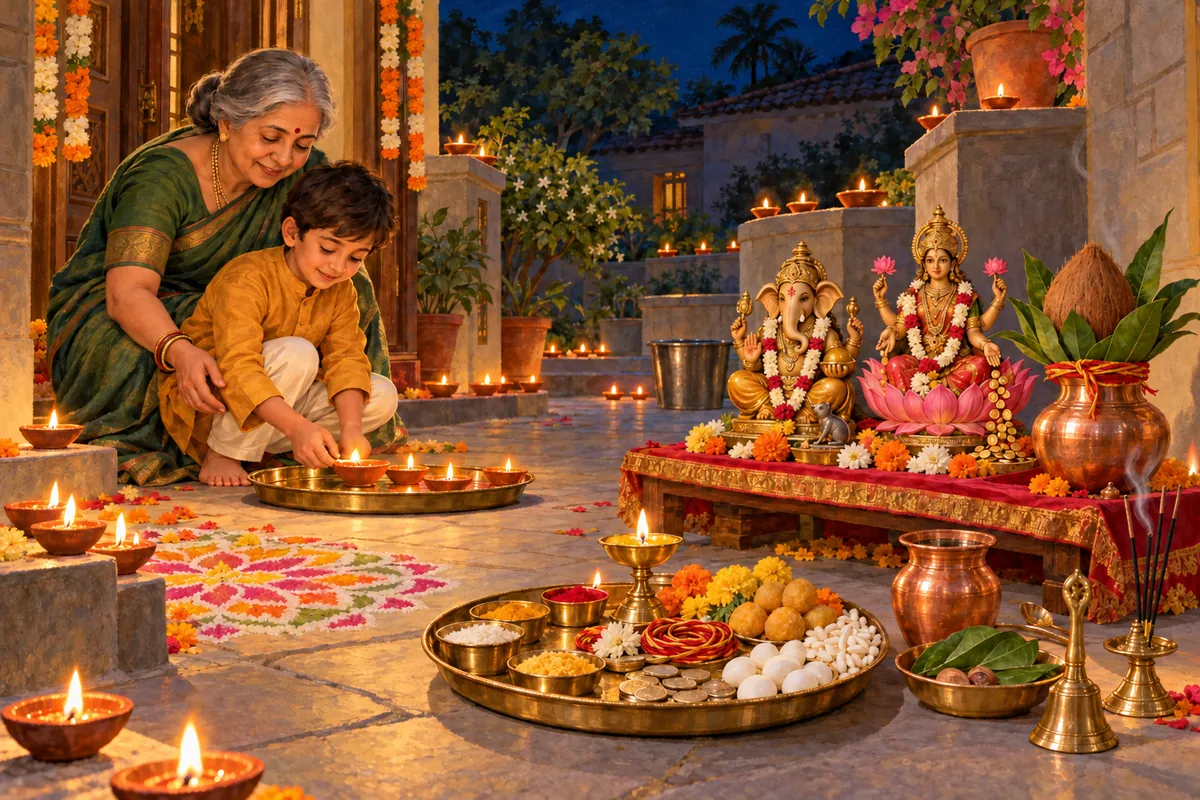
Shubh Deepavali.
If something here differs from your family's practice, follow your family.